This document tells you which of three levels of AI adoption your engineering team is on, using signs you can see in a week, and what moved real teams from one level to the next. Start with the ten question self check; the rest explains what each answer means.
1. Why "adoption" is the wrong number
Survey after survey reports adoption near 90%, and each one reports a different second number that matters more.
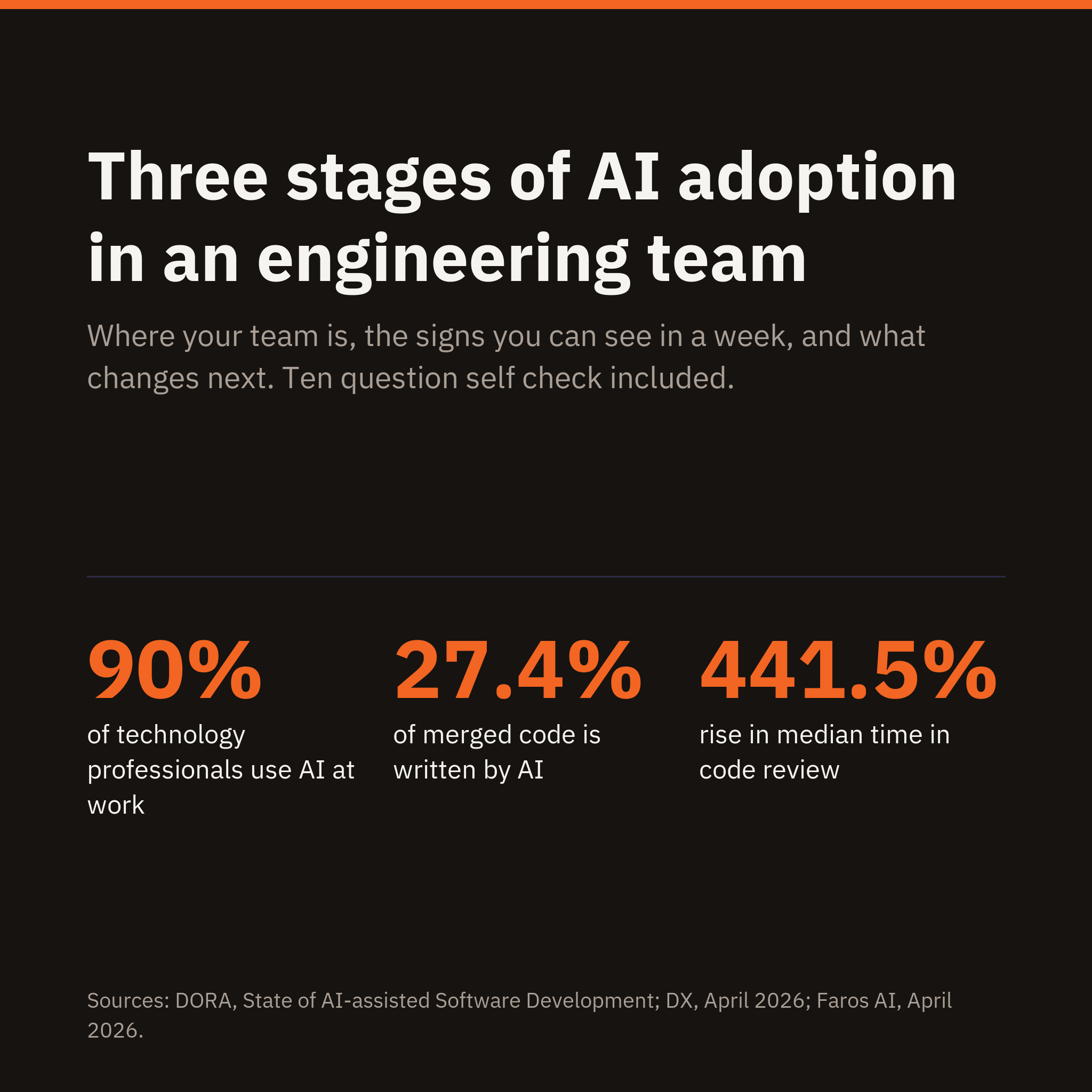
The 2025 State of AI-assisted Software Development report by DORA, Google Cloud's DevOps Research and Assessment program, based on responses from nearly 5,000 technology professionals, found that 90% report using AI at work and more than 80% perceive that it increased their productivity. But only 65% rely on AI "at least a moderate amount", and 60% use it about half the time or more when they hit a problem. Nine in ten touch it. Six in ten lean on it.
DX, which measures AI use at more than 500 organizations each quarter, reported on April 1, 2026 that the average share of merged code written by AI moved from 22% to 27.4% between two quarters. Among daily users the figure was 30.8%. DX's own reading: the tooling improved faster than teams adapted to it.
Faros AI's 2026 engineering report, built on two years of telemetry from 22,000 developers and more than 4,000 teams, found that 80% of teams now exceed the 50% weekly active user threshold for AI tools and that the acceptance rate of generated code rose from 20% to 60%. The same report found median time in code review up 441.5% and incidents per merged pull request up 242.7% between periods of low and high adoption. Faros's September 2026 update, on the most recent twelve months, puts unreviewed merges up 76.3% and incidents per pull request up 14.5%: the damage per change eased, the review gap widened.
Jellyfish's 2026 State of Engineering Management report, a survey of more than 635 CTOs, engineering managers and engineers, found that 91% say their team's productivity increased in the past twelve months, 84% say productivity is a top management concern, and 64% report a velocity increase of 25% or more with AI.
Put those together and the picture is not "adopted or not". It is a team where nearly everyone has a license, a third of the merged code comes from an agent, the review queue is the new bottleneck, and management is convinced it is working while still worried about it. Which of those sentences describes your team depends on the level it is on.
2. Level 1. Mandate without practice
What it looks like. The board or the CEO asked for results with AI. There are licenses. Each developer uses them their own way, mostly for autocomplete and questions. There is no standard for what gets delegated to an agent, no rule for how generated code is reviewed, and no baseline to compare against. Someone was recently named responsible and does not know where to start.
Signals you can observe in a week.
- Weekly active use of the tools is below half the team, or nobody can tell you the number.
- No file in the repository tells the agent how the codebase is organized or what the conventions are.
- Pull requests look the same size and shape they did a year ago.
- The word "AI" appears in the roadmap but not in the definition of done.
What the sources say about this level. DORA's 2025 model lists a clear and communicated AI stance as one of seven capabilities that amplify AI's effect; without it, DORA writes, developers act either too conservatively or too permissively, and use goes underground. McKinsey's August 2026 global survey found that 80% of respondents say AI improved their individual productivity while only 37% of the same respondents of organizations report any effect on earnings. Level 1 is where that gap lives: individuals gain, the team does not.
What changes next. One team, not the whole organization. A written stance (which tools, for what, reviewed how). Tools configured to the stack. A baseline taken before anything else: cycle time, review time, rework rate, share of the team with AI in its daily flow.
3. Level 2. Half the team adopted, the other half did not
What it looks like. Some developers visibly produce more with agents. Others do not touch them or do not trust the output. The quality of generated code varies by who prompted it. Review has become the bottleneck, and nobody can say with numbers whether the team is faster. Among the teams we see, this is the most common level and the one we have spent the most time in.
Signals you can observe in a week.
- Two or three people account for most of the agent generated pull requests.
- Median time to first review is climbing, and senior engineers are the ones absorbing it.
- Pull requests got bigger. Faros measured PR size up 51% and bugs per PR up 28% under high adoption.
- At least one incident in the last quarter was attributed, out loud or quietly, to code nobody read.
What the sources say about this level. Faros calls it the senior engineer tax: median time in review up 441.5%, average time in review up 199.6%, and pull requests merged with no review at all up 31.3%, because reviewers cannot keep pace. GitClear, on 623 million code changes from 2023 to 2026, found duplicated blocks up 81% and refactoring down to 3.8% of changed lines. DORA's capabilities for this stage are working in small batches (amplifies AI's effect on product performance and turns friction into a net positive) and strong version control practices, including frequent rollback.
What changes next. The senior who already works well with agents stops being an exception and becomes the standard: a delegation list (what the agent does alone, what it does with supervision, what it never does), a review rule that runs on every generated change before a human looks, and a PR size limit that is enforced. The developers who have not adopted yet are brought in on real tickets, next to that senior, not in a training. Before and after metrics are published to the team.
4. Level 3. The practice exists and they want to take it everywhere
What it looks like. One team works well with agents and has measured the improvement. The organization wants to replicate it in five teams, extend it to QA, CI/CD, documentation and integrations, and make it survive when the two enthusiasts who built it rotate out.
Signals you can observe in a week.
- The pilot team can show a before and after with the same metrics it used at Level 1.
- Conventions, review skills and context files live in the repository, not in someone's head.
- QA or platform teams are asking when their turn comes.
- Leadership is asking about cost per token for the first time. McKinsey found about one in five organizations already limiting AI use because of operating costs.
What the sources say about this level. DORA's remaining capabilities are the ones that matter here: AI accessible internal data (a multiplier for individual effectiveness and code quality), healthy data ecosystems (amplifies the effect on organizational performance), a quality internal platform (when platform quality is high the effect of AI on organizational performance is strong and positive; when it is low, negligible) and a user centric focus (without it, DORA writes, AI can propel a team faster in the wrong direction). McKinsey's high performers, 6% of respondents, are the ones who redesign workflows rather than insert AI into existing ones: nearly three quarters of them did, against one quarter of everyone else.
What changes next. A pod, not a person: several seniors with specialties (development, automated QA, platform) working across teams with a formal transfer plan. The practice becomes part of the platform. Measurement moves from the team to the organization.
5. A ten question self check
Answer yes or no. Mostly no in the first block means Level 1. Yes in the first block and no in the second means Level 2. Yes in both means Level 3.
Block one.
- Can you state the share of the team with AI in its daily flow, from data rather than a guess?
- Is there a written stance on which tools are allowed and for what?
- Does the repository contain context for the agent (architecture, conventions, how to run tests)?
- Did you take a baseline of cycle time, review time and rework before the initiative?
- Is one team, with one owner, running the practice on real tickets?
Block two.
- Is there a delegation list that says what the agent does alone and what it never does?
- Does an automated check run on every generated change before a human reviews it?
- Has median time to first review stopped climbing?
- Can the pilot team show a before and after with the Level 1 metrics?
- Would the practice survive if the two people who built it left?
6. What we have seen move a team one level
Three things, in every team where it worked.
The first was a senior inside the team, not a consultant beside it, doing the same tickets as everyone else with the agent and showing the work. Developers copy what they see a peer do on their own codebase. They do not copy a slide.
The second was measuring before touching anything. The teams that skipped the baseline spent the following quarter arguing about whether it was working. The teams that took it spent that quarter improving the number.
The third was treating review as the product of the practice rather than its casualty. Every time a reviewer caught the same kind of mistake twice, that mistake became a rule the agent read or a check that ran before the pull request opened. The review queue came down not because people reviewed less, but because less arrived that needed a senior.
None of this is a statistic. It is what held.
Questions and answers
How do you know which level your team is on?
Answer the ten yes or no questions in two blocks. Mostly no in the first block means level one, mandate without practice. Yes in the first block and no in the second means level two, half the team adopted. Yes in both means level three, a working practice the organization wants to extend.
What is the senior engineer tax?
It is Faros AI's name for what happens to review when generated code arrives faster than people can read it. Senior engineers absorb the queue: average time in review rose 199.6% and pull requests merged with no review at all rose 31.3% between periods of low and high adoption.
What should a team do first at level one?
Start with one team, not the whole organization. Write a stance on which tools are used, for what, and reviewed how. Configure the tools to the stack. Before anything else, take a baseline of cycle time, review time, rework and the share of the team with AI in its daily flow.
What does a team need at level three that it did not need before?
A pod instead of a person: several seniors with specialties in development, automated testing and platform, working across teams with a formal plan to hand the practice over. The practice becomes part of the internal platform, and measurement moves from the pilot team to the organization.
Sources
- DORA (Google Cloud), 2025 State of AI-assisted Software Development, infographic and DORA AI Capabilities Model, September 2025. https://dora.dev/research/2025/dora-report/ and https://dora.dev/capabilities/
- DX, AI-generated merged code holds steady at ~30%, April 1, 2026. https://newsletter.getdx.com/p/ai-generated-merged-code-holds-steady
- Faros AI, Ten takeaways from the AI Engineering Report 2026: The Acceleration Whiplash, April 12, 2026. https://www.faros.ai/blog/ai-acceleration-whiplash-takeaways
- Faros AI Research, The Speed Trap: 8 takeaways from our latest AI engineering research, September 18, 2026. https://www.faros.ai/blog/ai-speed-trap-takeaways
- Jellyfish, 2026 State of Engineering Management Report, May 2026. https://jellyfish.co/resources/2026-state-of-engineering-management-report/
- GitClear, The Maintainability Gap: AI Code Quality in 2026, 2026. https://www.gitclear.com/the_ai_code_quality_maintainability_gap
- McKinsey, The state of AI in 2026: On the road to ROI, August 25, 2026. https://www.mckinsey.com/capabilities/quantumblack/our-insights/the-state-of-ai
Analysis and conclusions by Viaro Networks, based on the published reports listed above. DORA material is used under CC BY 4.0.