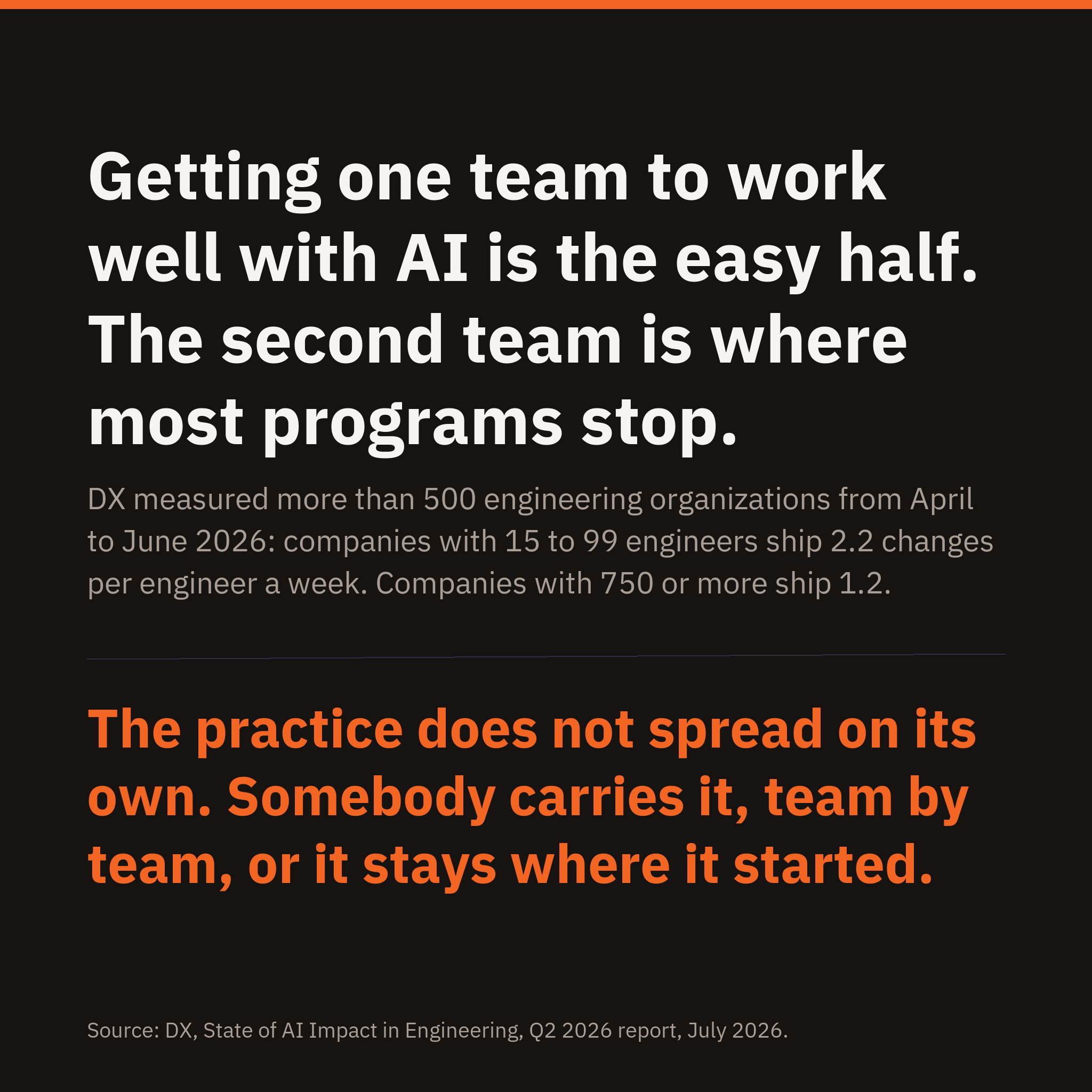
Getting one team to work well with AI is the easy half. The second team is the hard half, and that is where the adoption programs we see stop.
DX, which combines system telemetry with survey answers from more than 500 engineering organizations, published its quarterly report on July 22, 2026, covering April through June. Organizations with 15 to 99 engineers merge 2.2 pull requests (ship 2.2 changes) per engineer per week. Organizations with 750 or more merge 1.2. The report publishes only those two ends of the range, so it does not say whether the drop in between is gradual. Across the whole sample, median weekly throughput rose 37% over four quarters, from 1.42 to 1.94 pull requests per engineer, while the developer experience index fell from 67 to 65, pulled down by review turnaround and local iteration speed. Change confidence, the trust that a change will not break something, fell 6.1%.
Our reading, not DX's: pull requests per engineer count the volume of changes, not their value, and two organizations that size their changes differently are not comparable on that number alone.
Martin Fowler, chief scientist at Thoughtworks, wrote on X on August 27, 2026 that making AI effective takes decent data underneath it: quality foundations, clear access, observability.
In client teams we see the same wall. The first team wrote its own rules, its own automated checks, its own way of splitting work. The second team gets the licenses and none of that.
The practice does not spread on its own. Somebody carries it, team by team, or it stays where it started.
Sources
- DX, State of AI Impact in Engineering, Q2 2026 report, July 22, 2026. https://www.getdx.com/news/dx-releases-q2-2026-state-of-ai-impact-in-engineering-report
- Martin Fowler on X, August 27, 2026. https://x.com/martinfowler/status/2092966191136493906