The first time I asked a client team what share of their merged code an agent had written, the answers ranged from 5% to 60% in the same room. That range, not the average, told me where the team was.
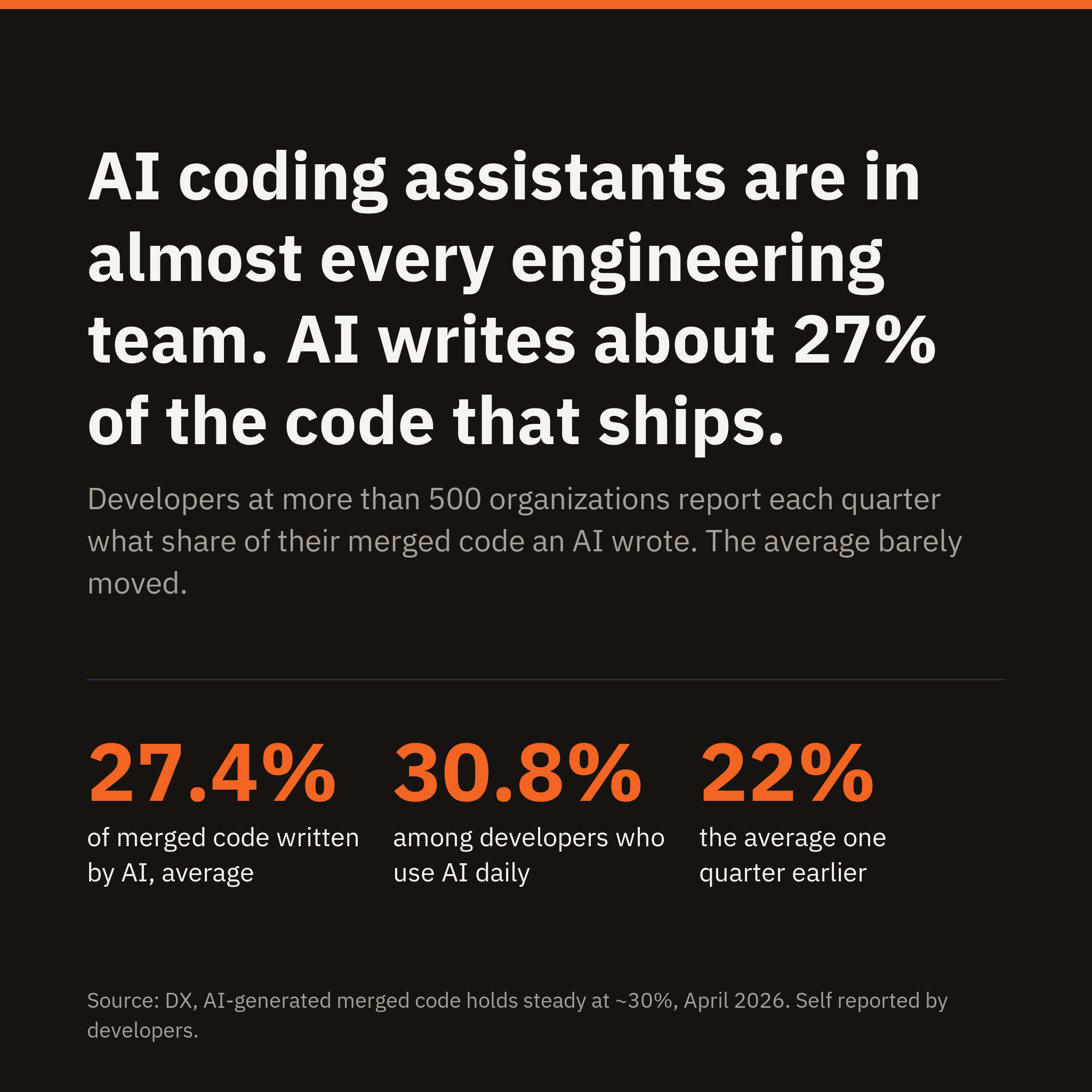
DX put a number on the average. Asking developers at more than 500 organizations each quarter, it reported on April 1, 2026 that the mean share of merged code written by AI went from 22% to 27.4% in a quarter, and to 30.8% among daily users. Weekly and monthly users barely moved. DX's reading: the tools improved faster than teams adapted, and developers still have to change workflows, trust the output and find where it fits before the share climbs.
The 60% in my room was a senior who had rewritten her workflow around the agent: a context file in the repository, a delegation list, tests written before the code. The 5% were good developers using the assistant for questions. Same license, same model, twelve times the merged share.
The team's number moved when the 5% sat next to the 60% on real tickets for a month. It never moved from a training.
Questions and answers
What share of merged code is written by AI?
According to DX, which asks developers at more than 500 organizations each quarter, the average share of merged code written by AI was 27.4% in the first quarter of 2026, up from 22% the quarter before. Among developers who use AI tools daily it was 30.8%.
How is that number measured?
It is self reported: developers say what share of their merged code they believe an AI wrote, and DX aggregates the answers by how often they use AI tools. DX has said it will compare this with a telemetry based measure taken directly from version control in future reports.
Why did the share barely move if the tools got better?
DX's own reading is that most teams had not yet adapted to the improvements. A more capable model does not translate into more merged code by itself. Developers have to update their workflows, build trust in the output and find the right use cases first. The segment that did adapt, daily users, saw the largest increase, from 24.1% to 30.8%.
What is the difference between AI adoption and AI written merged code?
Adoption says who has a license or uses an assistant. The merged share says how much of what actually shipped an agent wrote. A team can report near universal adoption and still have most developers using the assistant for questions, with a merged share that has not moved.
What separates the developers with a high merged share from the rest?
In the client teams I have worked with, the difference is the workflow, not the tool. The developers with a high share rewrote how they work around the agent: a context file in the repository that explains the codebase, a list of what the agent may do alone, and tests written before the code. The rest kept their old workflow and added an assistant to it.
How does a team raise its merged share?
Put the developers with a low share next to the ones with a high share on real tickets, for weeks, not in a training. In my experience the team's number moves when people copy what a peer does on their own codebase.
Sources
- DX, AI-generated merged code holds steady at ~30%, April 1, 2026. https://newsletter.getdx.com/p/ai-generated-merged-code-holds-steady
